Every summer puts trees in the East Bay to the test.
Weeks of high temperatures, dry conditions, and compacted clay soils can leave even healthy trees looking tired by late summer. But once temperatures begin to moderate, many homeowners wonder:
Is my tree starting to recover, or is something still wrong?
The good news is that many trees can recover from seasonal stress with the right conditions. The challenge is knowing the difference between normal recovery and signs that your tree is continuing to decline.
Here’s what to watch for.
Why Summer Stress Happens in the East Bay
Trees throughout Contra Costa County face several challenges during the hottest months of the year.
Common causes include:
- Extended periods of drought
- High temperatures and heat waves
- Heavy clay soils that limit root oxygen
- Soil compaction from foot traffic or construction
- Increased pest activity on weakened trees
- Competition for water from surrounding landscape plants
Stress doesn’t necessarily mean your tree is dying. It simply means the tree has been forced to use more energy than it can replace. Many species are capable of recovering once growing conditions improve.
Signs Your Tree Is Recovering
Recovery often happens gradually rather than all at once.
Positive signs include:
Healthy Bud Development
Trees preparing for the next growing season will often begin forming healthy buds, even if leaves were sparse during summer.
Stable Leaf Color
Leaves should remain a consistent green for the species.
While a few damaged leaves may remain, widespread yellowing or browning should stop progressing.
Little to No New Dieback
If branch tips are no longer dying back and the canopy appears stable, that’s often a positive indication that the tree is no longer under increasing stress.
Firm, Healthy Bark
Healthy bark should remain attached and free of new cracking, peeling, or sunken areas.
Improved Soil Moisture
Proper deep watering allows roots to begin recovering after months of heat.
Healthy soil conditions are often the first step toward healthier canopies.
Signs Your Tree May Still Be Declining
Not every stressed tree rebounds on its own.
If symptoms continue or worsen after the hottest part of summer, further evaluation may be needed.
Watch for:
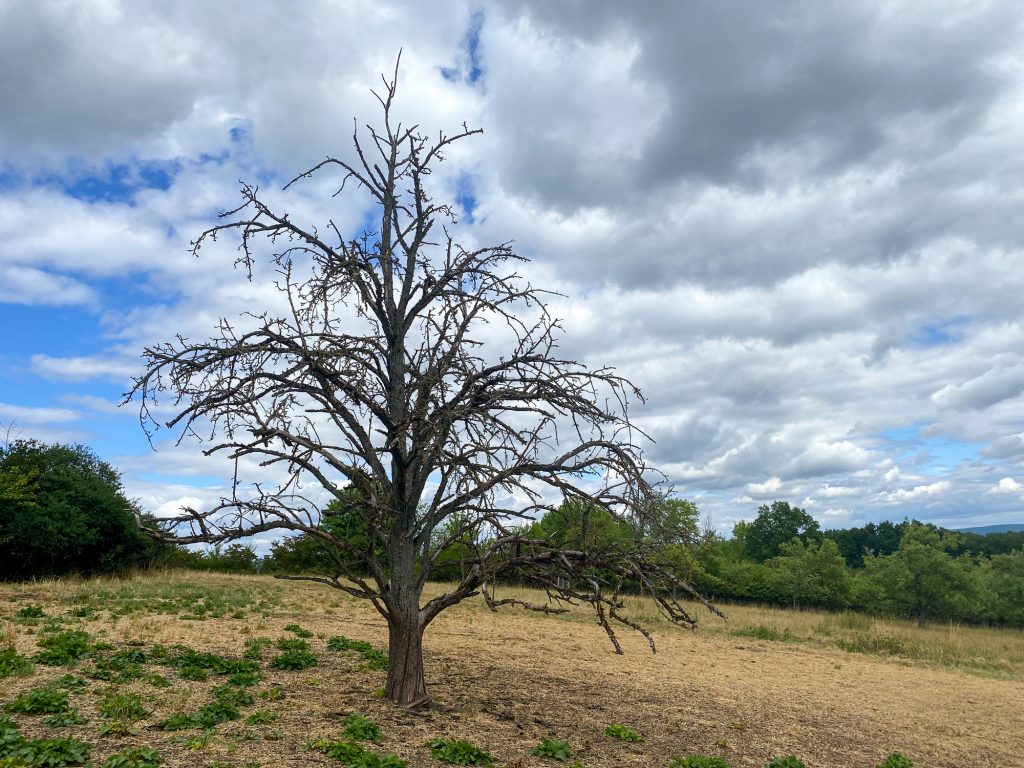
- Dead branches appearing throughout the canopy
- Large sections failing to produce leaves
- Bark peeling or cracking
- Mushrooms growing near the base of the tree
- New insect activity or boring holes
- Continued thinning of the canopy
- Leaves becoming progressively smaller year after year
When several of these symptoms appear together, they often indicate a more significant underlying problem.
Summer Stress Can Attract Pests
One challenge many homeowners don’t realize is that stressed trees become more attractive to insects.
In the East Bay, weakened trees are more susceptible to pests such as:
- Bark beetles
- Invasive Shot Hole Borer (ISHB)
- Sycamore borers
- Aphids and scale insects
Many of these pests are drawn to stressed trees, making early intervention important before infestations become severe. Evergreen Tree Care emphasizes proactive plant health care and maintaining tree vigor to reduce pest pressure.
How You Can Help Your Tree Recover
Recovery isn’t about doing more. It’s about doing the right things.
Water Deeply
Provide slow, deep watering rather than frequent shallow irrigation.
Deep watering encourages stronger root development and better drought resilience.
Avoid Heavy Pruning
Unless you’re removing hazardous branches, avoid significant pruning while the tree is recovering.
Leaves are producing energy the tree needs to rebuild its reserves.
Protect the Root Zone
Avoid:
- Parking vehicles beneath trees
- Heavy foot traffic
- Digging near roots
- Piling mulch against the trunk
Healthy roots are essential for full recovery.
Improve Soil Health
Many stressed trees benefit from professional soil care.
Depending on the tree and site conditions, an arborist may recommend:
- Deep root fertilization
- Air spading to relieve soil compaction
- Vertical mulching
- Growth regulators to improve drought resilience
These treatments are designed to improve long-term tree health by supporting the root system and reducing environmental stress.
When Should You Have an Arborist Inspect Your Tree?
If your tree isn’t showing noticeable improvement after summer or symptoms continue to worsen, it’s time for a professional evaluation.
An ISA Certified Arborist can determine whether the tree is:
- Recovering normally
- Experiencing root damage
- Under pest or disease pressure
- Suffering from soil-related problems
- Developing structural concerns that require attention
Early diagnosis often provides more treatment options than waiting until decline becomes advanced.
Why Recovery Looks Different for Every Tree
Not all trees recover at the same pace.
Recovery depends on factors including:
- Tree species
- Age
- Root health
- Soil conditions
- Amount of drought stress
- Previous pruning history
- Pest or disease activity
A mature coast live oak may recover differently than a sycamore or Monterey pine growing in the same neighborhood.
That’s why professional evaluation is often the most reliable way to understand what your specific tree needs.
Frequently Asked Questions
Can a tree recover after a severe summer drought?
Yes. Many trees recover when they receive proper watering and growing conditions improve. However, prolonged drought can cause lasting root damage that requires professional care.
How long does it take a stressed tree to recover?
Some trees begin showing improvement within weeks, while others may take an entire growing season or longer depending on the severity of the stress.
Should I fertilize a stressed tree?
Not always. Fertilization should be based on the tree’s condition and soil health. In many cases, deep root fertilization or other plant health care treatments are more appropriate than applying general fertilizer.
Can summer stress make trees more likely to get insects?
Yes. Many wood-boring insects are attracted to stressed trees, making preventative tree health care especially important during and after periods of drought.
Should I remove a tree that looks stressed?
Not necessarily. Stress is often reversible, while decline is progressive. An ISA Certified Arborist can determine whether your tree is recovering or if removal should be considered.
Help Your Trees Recover Stronger
A tree that looks stressed today isn’t always beyond saving, but waiting too long can allow small problems to become much more expensive ones.
At Evergreen Tree Care, our ISA Certified Arborists provide professional tree inspections, Plant Health Care services, soil improvement, and advanced diagnostics to help homeowners throughout Pittsburg, Contra Costa County, and the East Bay protect their valuable trees. With more than 40 years of local experience, we focus on long-term tree health through science-based recommendations, industry best practices, and a safety-first approach.
Call us today at 925-825-8165 to schedule your consultation, or contact us online.